

Case Study
StyleSwipe: swipe fashion, buy on the retailer
Swipe fashion discovery with a cross-retailer saved list. Live at styleswipe.yomite.in with property tests and ten Playwright flows.

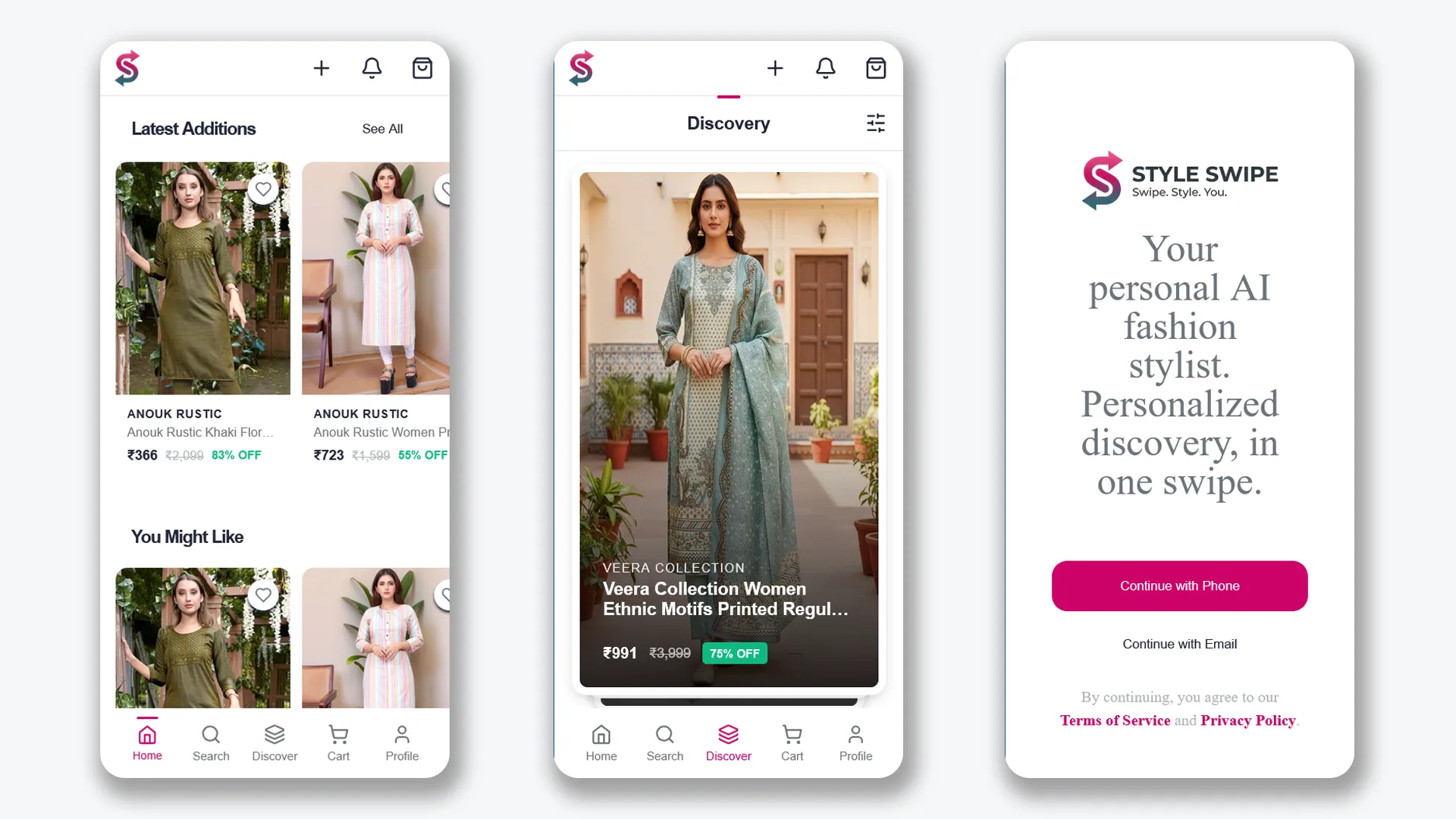
Try the web build at styleswipe.yomite.in. It deploys from main through Cloudflare Pages.
Indian apparel shoppers face endless scrolling through thousands of products, most irrelevant to their taste. They stall, they tire, they abandon. StyleSwipe answers with two shopping moods: explore and be inspired, or search with intent. The two-moods hypothesis comes from the concept PRD: browsers want inspiration, hunters want intent, and one feed cannot serve both.
What it is
Discover Mode shows one product at a time. Swipe right to like, left to pass. Every swipe feeds the recommendation engine, which retunes the feed in real time as taste changes. Shop Mode is the familiar grid for T-shirts, jeans, kurtas and dresses, with filters and search for the shopper who arrived knowing.
The bag is a cross-retailer saved list. Save a kurta from one store and jeans from two others, then buy each where it lives. StyleSwipe aggregates and never transacts: purchase happens on the merchant through affiliate links.
The bag flow, simplified:
graph TD
    Save[Save across<br/>retailers] --> Bag[Cross-retailer<br/>saved bag]
    Bag --> Merchant[Buy on<br/>the merchant]
    Merchant --> Affiliate[Affiliate link<br/>pays out]
Around the shopper app sit three more pieces: an admin panel for merchandising ops including catalog rescrapes, a browser extension target and a scraper service that crawls retailers and feeds products into the catalog. I build solo with agentic workflows. The hexagonal boundaries, each app split into an isolated core with ports and adapters, exist so one person can hold all four apps without them collapsing into each other.
Product decisions
No checkout on purpose
Orders, payments, returns and fraud stay with the retailers. The product owns discovery and taste, which is the part shoppers actually enjoy. Affiliate links monetize without a ledger. The trade is honest: thin commissions, attribution that ends at the handoff, and stale prices whenever a scraper breaks. We give up margin and control, and skip logistics entirely.
Two moods, one engine
The swipe deck serves the browser. The grid serves the hunter. Both read from the same StyleDNA profiles, so a like in Discover Mode sharpens Shop Mode results. Neither mode asks the shopper to explain their taste in words.
The taste loop, simplified:
graph TD
    Discover[Discover<br/>Mode swipe] --> DNA[StyleDNA<br/>profile]
    DNA --> Feed[Retuned feed]
    Feed --> Discover
    DNA --> Shop[Shop Mode<br/>grid]
    Shop --> DNA
The taste math lives in one place
The taste engine lives apart from the interface, so recommendation quality gets tested and iterated without touching a screen. That separation is what lets one person hold four apps.
One visual language across four apps
@app/ui-kit is pure Tamagui with a hard rule: never hardcode colors, always use tokens. Four apps share one look because none of them may invent one.
Distribution is the open question
Nobody has found these tools through marketing, because there is none yet. The live build tests whether the product holds attention. First prove people stay. Then find more of them. Underneath, property tests cover the matching logic, Playwright covers five shopper flows and five ops flows, and every PR gets a preview URL before main promotes to production.
What is next
No adoption numbers yet, so catalog depth comes before promotion:
- Stock the shelves. More retailers through the scraper service, so the feed stops repeating and the long tail of Indian fashion shows up.
- Sharpen the matches. Better seed data and a tighter swipe feedback loop, so week-two recommendations beat week-one guesses.
- Keep the bag honest. Saved items stay priced and stocked right, so the list you built last month still buys cleanly today.

Written by
Prathamesh Pathak
Building AI-native products. Writing about PM craft, career growth, and shipping.
Visit LinkedIn →More case studies
Cloud coder: selling dev tools to non-dev companies
Week one showed over ten lakh rupees in monthly recurring pipeline. AI coding environments for agencies and non-engineering firms, scoped tight for launch.
 Prathamesh Pathak · ·3 min read
OK analytics: the funnel before the fix
OK leadership flew blind on pricing, carts and catalog. I scoped a 5-week Mixpanel integration across client and server with identity stitching and nine answered business questions.
Prathamesh Pathak · ·5 min read